I was a victim of a series of accidents, as are we all
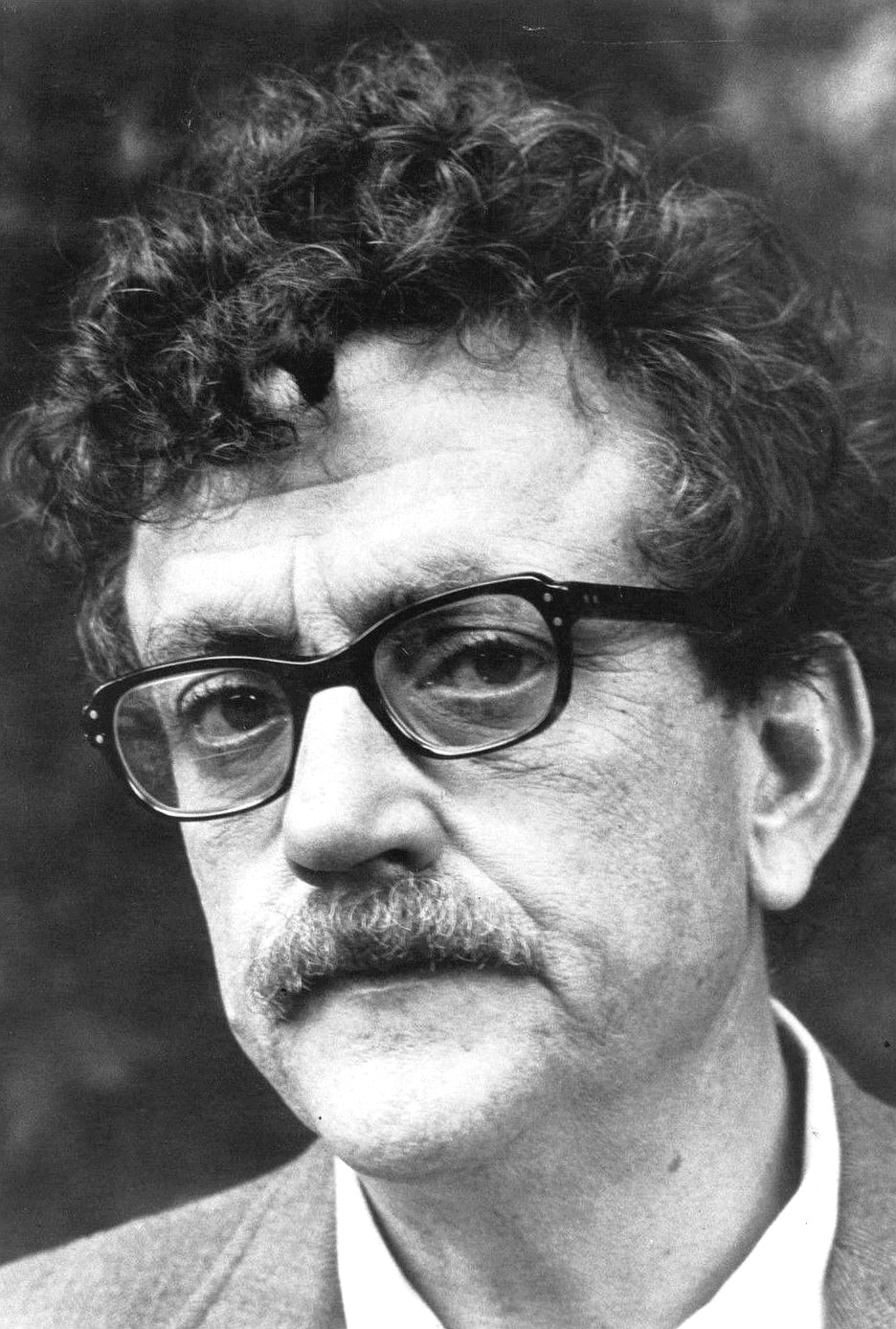
I first encountered Kurt Vonnegut’s books one sunny afternoon on the south coast of England. Someone had lent me a copy of Slaughterhouse Five to read a few weeks prior and I had slipped it into my rucksack before starting my first attempt at long distance walking. I had chosen, rather naively, the South West Coastal Path simply because it was an area I was un-familiar so therefore be interesting to visit. And one which I had decided I couldn’t get lost on, so long as I kept the sea on my right hand side. What I didn’t know was that the SW Coastal Path was notoriously hilly, with chalky cliffs rising spectacularly and then falling dramatically down to hollow bays that reached to the sea. All this with a heavy rucksack and a sweltering early English summer meant it was hard going and my daily mileage was low. Having woken up early one morning, packed up my tent, eaten breakfast and marched to Lulworth Cove by twelve noon, I found the next stage on my journey blocked by a wall with a locked gate. Enquiring in a local shop I was informed that “the Range” beyond the gate was closed for army shooting practice till Saturday. Luckily it was Friday and I only had a day to kill before I could continue my walk but it was a bit of a blow having psyched myself up for being in Swanage by the day after. So faced with an amount of idleness on my hands I sat on the cliff top above the cove and fished into my super sized bag till I found Slaughterhouse Five. And I read and read. I read till the sun went down and I had to set up camp in a nearby field. And thus started my continuing infatuation with Mr. Vonnegut. I’m still working my way through his books, but I thought it was about time I did a little investigation into what makes them so memorable.
One of the recurring themes of Vonnegut’s books that stand out for me is that many of his characters seem to lack agency in the world. It often seems like their destinies are planned or pre ordained (Much like my inability to continue my walk that day in Lulworth!) The plots in most of his books are driven by factors beyond man’s control, be they external events, alien interferences, time slips or internal chemical imbalances.
Vonnegut is very much an author of the 20th century, he is a man shaped by its most important events: the Second World War, the Atomic Era, globalisation and of course technological advancement beyond man’s wildest dreams. Wildest nightmares, perhaps? For the average man it often seems that these global events are beyond our control, we can only react. Vonnegut attempts, often through humour and an acceptance of fatalism, to look at ways we can cope with the knowledge that our actions, therefore our destinies, may not be our own.
His most famous novel, the one I have already mentioned, Slaughterhouse Five centres round his recollections of the destruction, by the Allied forces, of Dresden in Germany; a catastrophic firebombing, a horrific and unimaginable event. This scene and stories about his war years have been visited a few times in his other short stories and novella (Armageddon in Retrospect)as Vonnegut seems to have attempted several times to put this story into print in exactly the right way. It’s not till Slaughterhouse Five that he seems to have achieved something he is mostly happy with. Vonnegut describes coming out of the concrete basement of the meat processing plant he and his fellow POW’s had been ordered to shelter in to find a world changed beyond recognition. Such was the impact of the war on the world as a whole, a total war that changed western society forever and ever.
Many of Vonnegut’s other novels are a retelling of how the 20th century was reshaped by these powerful and inhumane forces.
So it goes.
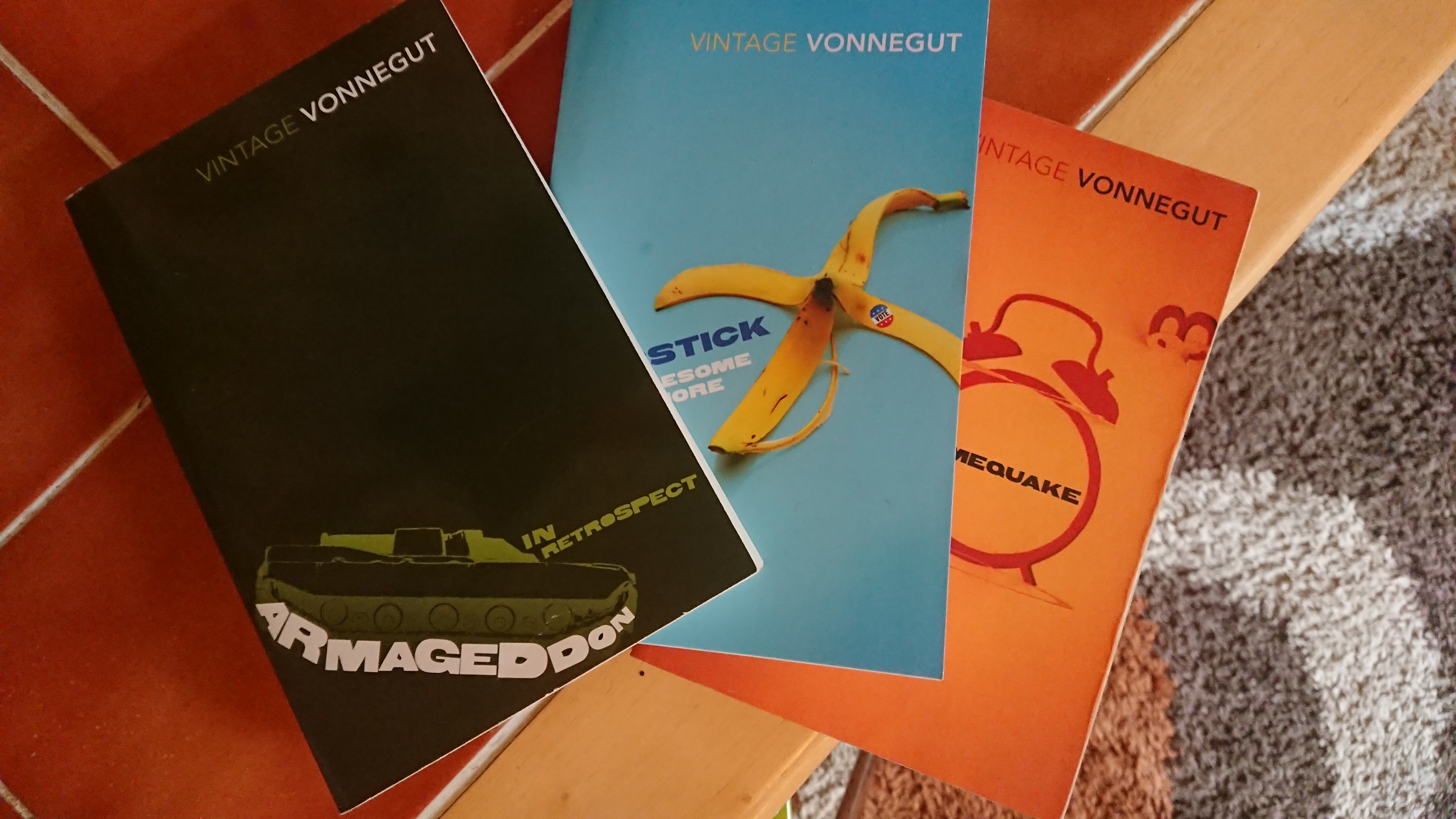
His book Slapstick wrestles with the way modernity is causing upheaval in 20th century American society. And to a greater extent the new feelings of loneliness and isolation our brave new world has engineered. Vonnegut recounts in his novel how in different parts of the USA different nationalities would originally settle in clusters. In particular the Germans who settled the Midwest, in states such Wisconsin, and Vonnegut’s own Indiana. Of course Vonnegut himself with a German name tells how people in the nineteenth century openly spoke German. Of how that part of the United States had a distinct German-American culture, until the First World War shattered that particular American identity apart. The German-Americans homogenised, disappeared into the ether, folded their language and culture into the Anglo-sphere for fear of being labelled spies or traitors – the enemy within. Vonnegut writes in Slapstick:
“Children in our family were no longer taught German. Neither were they encouraged to admire German music or literature or art or science”
Families and communities across the United States have been shattered apart by “progress”, spread thinly across the mega state. Nobody has any relatives any more, Vonnegut said when asked in an interview about Slapstick:
Until recent times, you know, human beings usually had a permanent community of relatives. They had dozens of homes to go to. So when a married couple had a fight, one or the other could go to a house three doors down and stay with a close relative until he was feeling tender again.
Hence the need for artificial family generated by the state, the character Wilbur, running for office as President comes up with the idea of having additional names and numbers assigned to citizens thus giving them a set of new roots and a sense of brotherhood wherever in the country they are. He demonstrated this by the reasoning that even a bum on the street would be no more lonesome than anyone else, no more worst off than the average American. Wilbur said he would say to them, if pestered for charity:
“Buster – I happen to be a Uranium-3. You happen to have one hundred and ninety thousand cousins and ten thousand brothers and sister. You’re not exactly alone in this world. I have relatives of my own to look after. So why don’t you take a flying fuck at a rolling doughnut? Why don’t you take a flying fuck at the moooooooooooon?”
Now loneliness will forever be eradicated – Lonesome No More! as the slogan on Wilbur’s badge proclaims, even as the power of the USA fractures into petty kingdoms and tribes, devastated by gravity fluctuations and disease, that at least people have their new families to cling to as the world falls apart.

In many of his novels it often seems like the entire 20th century is depicted be like a nightmarish ride. Characters in his stories appear to be pawns in schemes controlled by greater external agencies. That unfathomable conspiracies move forward the plot, the motivations are deeper and darker than the characters comprehend, often more some than they even can comprehend. Indeed in Breakfast of Champions the narrative is revealed to be controlled by an invisible author – Vonnegut himself is pulling the plot strings. He tells this to the ubiquitous Kilgore Trout, the beleagued science fiction author who appears in so many of Vonnegut’s works, playing different roles having a slightly different backstory every time. It could be argued that Trout often is a substitute for Vonnegut in the stories, the character who sometimes most often resembles the author himself, an outsider, an author of science fiction. But however in Breakfast of Champions, Vonnegut himself appears in the text to reveal to Trout that the entire universe is his creation by his pen. That Trout and the others characters are mere creations of the author with no free will of their own. That the universe is in fact completely machine like. The humans are machines also; reacting to certain chemical balances and inbalances in their brains to produce their actions. Vonnegut is like a god, ruling over his characters.
An example of Vonnegut’s depiction of the powerlessness of man comes from the nature of Billy Pilgrim’s existence. In Slaughterhouse Five, Pilgrim, is described as having “come unstuck in time.” Thus Pilgrim has no agency over his actions; his destiny is set in stone, from the date of his birth to his dramatic murder. He can visit all of these locations in no sequential order and relive each part at any time seemingly at random. This is how existence is seen by the Tralfamadorians, an alien race who feature in several Vonnegut novels. They are at peace with understanding that the universe is unchangeable, they know how the universe began, they too know how the universe will end. Both these events are unavoidable, so why worry? Free will may not exist at all, but Vonnegut repeatedly implores the reader to thus make the most of here and now. My favourite Kurt Vonnegut quotation is one he attributes to his Uncle Alex;
“I urge you to please notice when you are happy, and exclaim or murmur or think at some point, ‘If this isn’t nice, I don’t know what is.”
For me, this sums up Kurt Vonnegut’s extraordinary outlook on life. A man who lived through the horrors of man’s cruel indifference to man, yet maintains a sense of humour and the feeling that life is somehow always worth living, no matter how horrible the horrible bits are. There is always something to be gained, to learn amongst the absurdity of existence. Life, like the 20th century, is a crazy ride that we should remember to sometimes enjoy.
“A purpose of human life, no matter who is controlling it, is to love whoever is around to be loved.”
 adventures in rhyme and space